
A mobile yard ramp creates a forklift route from ground level to a truck or shipping container. However, capacity alone does not determine whether a ramp will work. Buyers must also check vehicle height, clear width, ramp geometry, forklift clearance and the available yard space.
This mobile yard ramp buying guide explains those decisions in the order that a project team should make them. First, confirm where the forklift starts. Next, calculate the complete moving load. Then check the geometry of the forklift, ramp and vehicle as one route. Finally, confirm that the site can support safe positioning and repeated loading.
Haolong publicly lists a 6–30T mobile yard ramp series. These website figures support early model comparison. They do not replace the approved drawing, quotation, load documentation, operating manual or inspection records for the unit supplied.
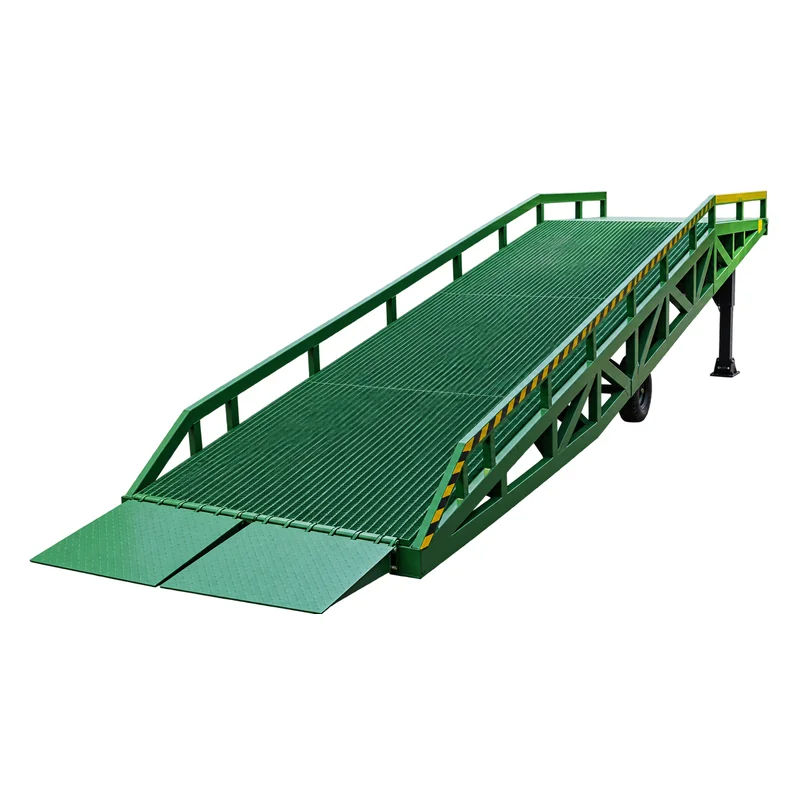
Start with the loading route: ground or raised dock?
Before comparing capacities, identify the forklift’s starting level.
A mobile yard ramp normally suits a forklift that starts at ground level. The ramp rises from the yard to the floor of a truck or container. Because operators can reposition it, one ramp may serve several loading points.
A stationary dock leveler starts from a different condition. The forklift already operates on a raised warehouse dock. The leveler only bridges the smaller gap and height difference between that dock and the vehicle.
| Selection question | Mobile yard ramp | Stationary dock leveler |
|---|---|---|
| Where does the forklift start? | Ground or yard level | Raised loading dock |
| Where does the equipment sit? | On the yard surface | In a prepared dock pit |
| Can the loading point change? | Yes, subject to the moving method | No, it remains at one bay |
| What height does it bridge? | Ground to vehicle floor | Dock floor to vehicle floor |
| What site work does it need? | Firm surface and enough approach space | Pit, dock interface and power supply |
| Typical use | Truck or container loading without a raised dock | Frequent loading at a permanent bay |
Therefore, do not choose between these products by tonnage. A 10T mobile ramp and a 10T dock leveler still solve different loading problems.
If the forklift starts from a permanent high-level dock, review a hydraulic dock leveler. If it starts from the yard, continue with the mobile ramp selection process below.
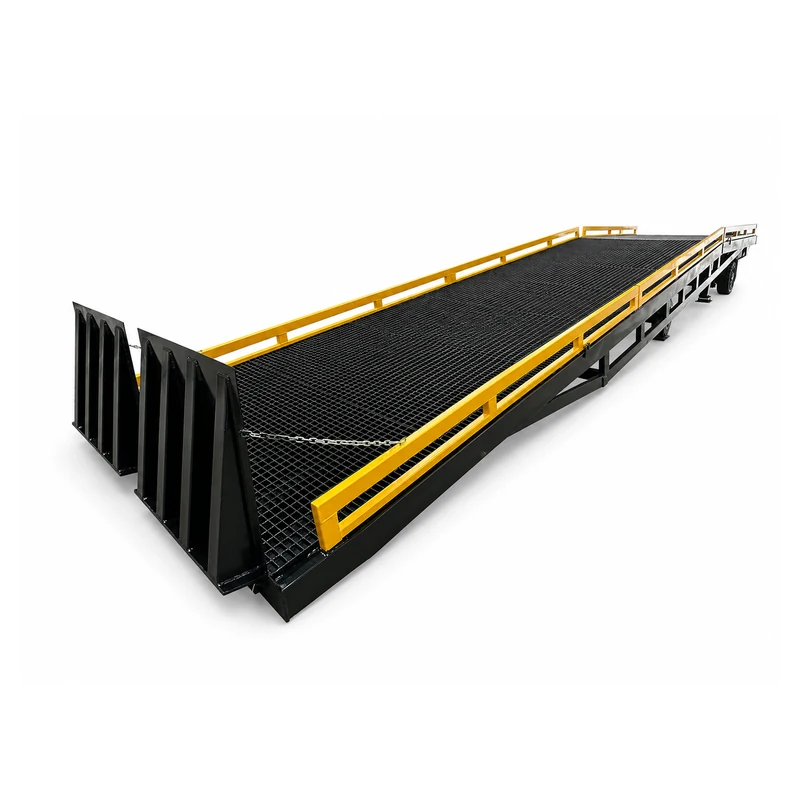
Step 1: Calculate the complete moving load
The rated capacity must cover everything that travels across the ramp:
Total moving load = forklift operating weight + operator + attachments + maximum cargo
Cargo weight alone does not provide a valid selection basis. In many applications, the forklift weighs more than the pallet or machine it carries.
In addition, forklift lifting capacity and forklift operating weight mean different things. A forklift rated to lift 3 tonnes does not necessarily weigh 3 tonnes. The counterweight, battery, mast, tyres and attachments all contribute to its actual operating weight.
Use the forklift data plate or manufacturer documentation to obtain the operating weight. Then add the heaviest cargo, operator and fitted attachments.
Example load calculation
| Load component | Example value |
|---|---|
| Forklift operating weight | 4,300 kg |
| Operator | 100 kg |
| Attachment | 250 kg |
| Maximum cargo | 2,500 kg |
| Total moving load | 7,150 kg |
This example establishes a 7,150 kg moving load. However, it does not prove that every nominal 8T ramp will suit the project. The supplier must also review wheel loads, load distribution, travel direction, duty cycle and ramp geometry.
For US workplaces, OSHA 29 CFR 1910.26(a) requires dockboards to support the maximum intended load. Projects in other countries may follow different standards, so buyers should identify the destination requirements before placing an order.
How should you choose between a 10T and 12T mobile yard ramp?
Treat 10T and 12T ramps as configuration options within the same product family, not as separate equipment categories.
First, calculate the total moving load. If that load approaches or exceeds the approved limit of a 10T configuration, ask the supplier to evaluate the 12T model. However, do not select 12T only because it sounds safer. A higher nominal capacity cannot correct unsuitable width, height range, surface conditions or forklift clearance.
The public Haolong product page currently shows the following reference configurations:
| Reference model | Capacity | Published overall size | Published clear width | Published height range |
|---|---|---|---|---|
| HL-YD-10T | 10T | 11,300 × 2,100 × 1,100 mm | 2,000 mm | 1,100–1,800 mm |
| HL-YD-12T | 12T | 11,300 × 2,300 × 1,100 mm | 2,200 mm | 1,100–1,800 mm |
These figures show why buyers should compare more than tonnage. In the published references, the 12T model also provides more clear width. Nevertheless, these website values remain preliminary selection data. Confirm the final capacity, dimensions, structure and working range in the project documents before production.
Step 2: Match the working height to the vehicle fleet
After capacity, measure the lowest and highest vehicle floors that the ramp must reach.
Do not rely on a general truck-height estimate. Suspension, tyre size, cargo and ground slope can change the actual floor height. Therefore, measure each relevant vehicle type at the intended loading position.
For container loading, measure from the yard surface under the ramp to the container floor. Record both the minimum and maximum values.
Haolong publicly lists model-dependent working ranges. Selected 6T, 8T, 10T and 12T references cover 1,100–1,800 mm. Meanwhile, some higher-capacity references use higher lower limits. As a result, buyers should never copy the height range from one model to another.
If the fleet falls outside a standard range, provide the measured values to the supplier. A custom height range can change the incline, total length, transition geometry and space requirement.
Step 3: Evaluate ramp geometry as a complete travel path
Ramp geometry controls whether the forklift can move from the yard to the vehicle without grounding, losing traction or making an abrupt transition.
Overall length and effective incline
A longer ramp generally reduces the incline for the same rise. However, overall length does not equal usable inclined length. Level sections, transition plates and structural details also occupy space.
Therefore, do not calculate a slope from the overall length alone. Ask the supplier for the approved side-view drawing and confirm the working angle at the lowest and highest operating positions.
The final incline must also suit the forklift manufacturer’s limits. Check gradeability, braking, traction and operating instructions for the actual forklift and load.
Forklift ground clearance and wheelbase
A forklift can contact the ramp even when its tyres remain on the deck. The key risks occur where the yard meets the ramp and where the ramp meets the vehicle.
A long wheelbase, low ground clearance or low-mounted attachment can increase the risk of contact at these transitions. Consequently, provide the supplier with:
- forklift wheelbase;
- minimum ground clearance;
- front and rear overhang;
- mast and attachment details; and
- vehicle or container threshold geometry.
The supplier can then review the approach and departure transitions against the actual machine.
Clear deck width
Compare clear deck width with the full travelling envelope, not just the forklift body.
Include the forklift tyres, cargo, attachments and necessary side clearance. In addition, check the vehicle doorway. The truck or container opening may create the narrowest point even when the ramp itself provides enough width.
Haolong’s public range lists model-dependent clear widths from 2,000 to 2,900 mm. Buyers should confirm the usable width between rails or other obstructions rather than relying on overall ramp width.
Transition plates and vehicle overlap
The front and rear transitions connect three different surfaces: the yard, ramp and vehicle floor. These interfaces affect tyre movement and forklift clearance.
Ask the supplier to show the approach section, upper transition and vehicle overlap on the drawing. Also confirm how the ramp connects to the truck or container during loading.
Step 4: Check the available yard space
A mobile yard ramp requires more space than its overall dimensions.
Haolong’s published standard references are approximately 11,300 mm long. However, the site must also provide room for the forklift to approach, align and turn. In addition, workers need space to position the ramp and vehicle.
Prepare a measured plan that shows:
- the available straight-line length;
- the truck or container position;
- the forklift approach direction;
- the required turning area;
- nearby walls, columns and kerbs;
- doors, canopies and overhead obstructions;
- drains, slopes and damaged surfaces; and
- the route used to move and store the ramp.
Photos help explain the location, but they do not replace measurements. Use a dimensioned sketch or site drawing whenever possible.
Step 5: Inspect the supporting surface
A mobile ramp needs a firm and level working area. Weak ground or a local slope can affect wheel support, frame position and alignment with the vehicle.
Before selection, record:
- pavement material and condition;
- visible cracks or settlement;
- cross-slope and longitudinal slope;
- drainage paths and standing water;
- kerbs, channels or embedded rails;
- indoor or outdoor exposure; and
- available space for supports and chocks.
Do not assume that a high-capacity ramp can compensate for poor ground. If the surface cannot provide stable support, correct the site or obtain a site-specific engineering assessment.
Step 6: Plan how the ramp and vehicle will remain secure
“Mobile” describes the ability to reposition the ramp. It does not mean that the ramp may move during loading.
Depending on the confirmed configuration, a working setup may use support legs, safety chains, wheel chocks, vehicle restraints and side protection. The operator must deploy each specified device according to the model manual.
For US operations, OSHA 29 CFR 1910.26(c)–(e) addresses several relevant requirements. Portable dockboards must remain in a safe position, the transport vehicle must not move while employees use the dockboard, and portable dockboards must provide a safe handling method.
Before ordering, ask:
- How will workers move the ramp?
- What towing or repositioning method does the manufacturer allow?
- How does the ramp connect to the vehicle?
- Which supports, chains and chocks come with the unit?
- How will the site prevent truck or trailer movement?
- What must operators inspect before use?
- What maintenance support and isolation procedures apply?
These questions support equipment selection. They do not replace operator training or the supplied manual.
Step 7: Define the operating frequency and environment
A ramp that handles several crossings per week faces a different duty cycle from one that handles repeated traffic during every shift.
Therefore, tell the supplier how many vehicles and forklift crossings you expect each day. Also explain how often workers will reposition the ramp.
Environmental conditions matter as well. Rain, ice, dust, mud and corrosive materials can affect traction, coating and maintenance. An open steel grating deck may allow water and loose debris to pass through, but operators must still keep the travel surface in suitable condition.
If the ramp works outdoors, discuss drainage, finish, visibility markings and the planned inspection schedule.
What information should a buyer send for quotation?
A complete enquiry should include the following information:
| Required information | Selection purpose |
|---|---|
| Forklift make and model | Identifies the correct machine configuration |
| Forklift operating weight | Forms part of the total moving load |
| Maximum cargo weight | Completes the load calculation |
| Operator and attachment weight | Prevents missing load components |
| Wheelbase and ground clearance | Supports transition review |
| Minimum and maximum vehicle height | Defines the working range |
| Forklift, cargo and doorway widths | Defines the travel envelope |
| Available yard length | Confirms whether the ramp will fit |
| Approach and turning area | Confirms forklift access |
| Surface condition and slope | Supports stability review |
| Daily loading frequency | Defines the duty cycle |
| Indoor or outdoor use | Informs deck and finish selection |
| Moving and storage route | Helps configure the mobility system |
| Destination country | Identifies relevant documents and requirements |
| Site drawing and photos | Shows the complete loading arrangement |
Ask the supplier to record the agreed capacity, dimensions, height range, supports, restraints and options in the quotation and approved drawing.
How to use Haolong’s published 6–30T range
Haolong publicly lists 6T, 8T, 10T, 12T, 15T, 20T and 30T reference models on its mobile yard ramp product page.
Use that range to identify possible configurations. Then narrow the choice with the actual moving load, working height, clear width and site layout.
Do not treat a web table as a load-test certificate or an inspection report for a delivered unit. The approved project documents should define the ordered configuration. Meanwhile, the applicable inspection and acceptance records should confirm the supplied equipment.
This approach keeps all capacities under one product and guide structure. It also avoids creating separate, repetitive buying guides for 10T and 12T ramps.
Common buying mistakes
Selecting by cargo weight only
This method ignores the forklift, operator and attachments. Instead, calculate the full moving load.
Using forklift lifting capacity as forklift weight
These values serve different purposes. Obtain the operating weight from the data plate or manufacturer.
Choosing a higher capacity without checking geometry
A 12T ramp may still fail to fit the vehicle height, forklift clearance or available yard space.
Checking overall width instead of clear width
Guardrails and structural elements can reduce usable space. Confirm the clear travel width.
Using one truck height for the entire fleet
Different vehicles can have different floor heights. Measure the lowest and highest cases.
Ignoring forklift clearance at the transitions
A forklift can ground at the lower or upper transition even when the ramp reaches the correct height.
Planning only for the ramp footprint
The forklift still needs approach, alignment and turning space.
Treating published dimensions as final production data
Website specifications help with early selection. The approved quotation and drawing should control the final order.
Frequently asked questions
Can one mobile yard ramp serve several truck heights?
Yes, if every vehicle floor falls within the approved working range. Measure the minimum and maximum heights and confirm them against the selected model.
Does a manual hydraulic mobile yard ramp need electricity?
Haolong’s published standard references use manual hydraulic height adjustment. That system does not need electricity for adjustment. However, powered options require separate electrical confirmation.
How much yard length does a mobile ramp need?
Start with the ramp’s overall length, then add the forklift approach and alignment area. The final requirement depends on the forklift turning radius, vehicle position and site obstacles.
Can a mobile yard ramp operate on a sloped yard?
Do not assume that it can. The ramp needs stable support and correct alignment. Provide the site slope to the supplier and correct unsuitable ground conditions before operation.
Is a 12T ramp always better than a 10T ramp?
No. The correct model must match the total moving load, width, vehicle height, forklift geometry and site. A higher capacity does not automatically make the complete loading route suitable.
When should I choose a stationary dock leveler instead?
Choose a stationary dock leveler when the forklift starts from a permanent raised loading dock and trucks regularly reverse to the same bay. Choose a mobile yard ramp when the forklift starts from ground level and the loading point may change.
Select the complete loading route, not one specification
A sound purchase decision follows a clear sequence. First, confirm that the forklift starts at ground level. Next, calculate the complete moving load. Then compare the working height, clear width, transitions and forklift clearance. Finally, check the yard surface, approach space, restraint method and duty cycle.
Haolong’s 6–30T public range provides a useful starting point, while the project documents define the final solution. To request a model review, send your forklift data, cargo weight, vehicle-height range and measured site layout through Haolong’s project enquiry form.
References
- Haolong, Mobile Dock Ramps for Forklift Loading
- Haolong, Hydraulic Dock Levelers, 8T & 10T
- U.S. Occupational Safety and Health Administration, 29 CFR 1910.26 Dockboards