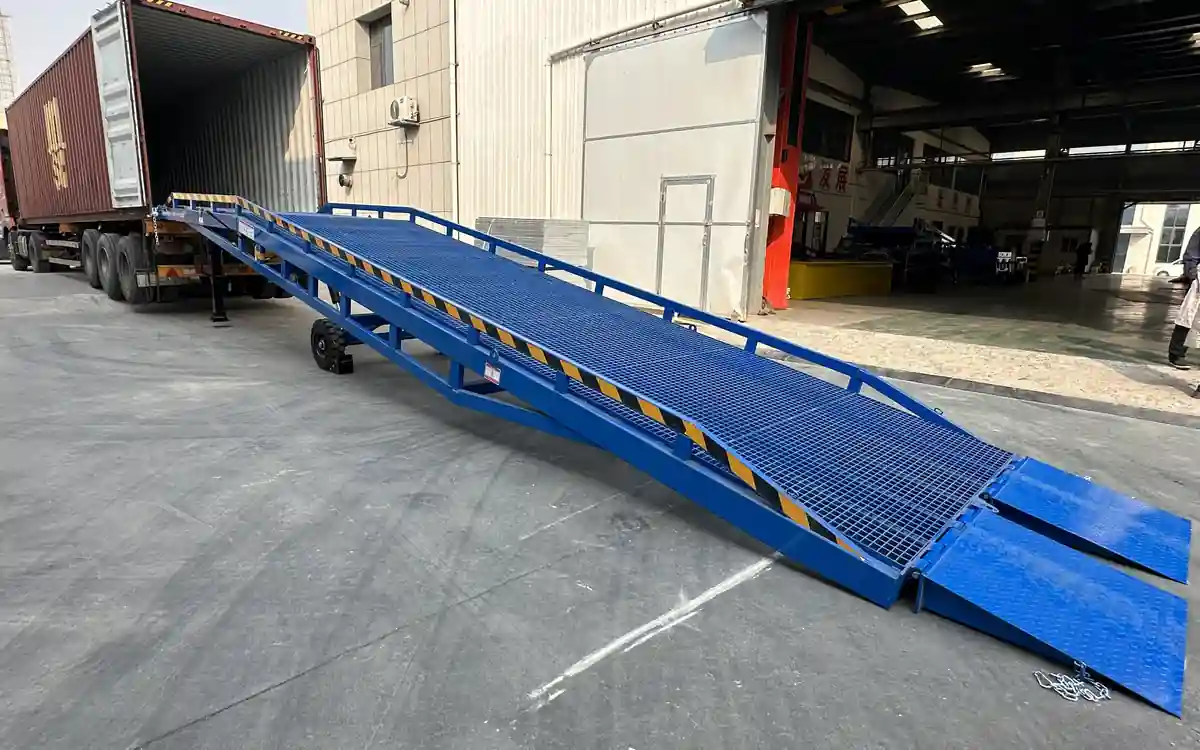
Ground-to-Vehicle Loading

Mobile Dock Ramp

A movable hydraulic ramp that creates a forklift route from ground level to trucks and containers—without a permanent loading bay or pit.

6–30T standard capacity range
1100–1800 mm typical height range
Manual hydraulic height adjustment
Width, height and finish configurable
Capacity range 6–30T Standard series
Overall length 11,300 mm Standard models
Clear width 2,000–2,900 mm Model dependent
Height range 1100–1800 mm Standard range
Where It Fits

Built for changing loading points

Choose a mobile dock ramp when forklifts operate from yard level and the loading position may change. One ramp can serve different vehicles, doors or temporary loading areas.

01

Container loading

Connect forklifts directly to shipping containers where no raised dock is available.

02

Warehouse yards

Move the ramp between loading positions to support mixed fleets and seasonal peaks.

03

Factory dispatch

Load palletized goods or machinery from ground level without permanent civil work.

Good fit when

The forklift starts at ground level, vehicle floor heights vary, and the loading position may need to move.

Consider another solution when

For repeated loading at a prepared raised dock, use a stationary dock leveler. For staging goods on a level work area, consider a mobile loading platform.

Specification Reference

Select capacity first, then confirm dimensions

Rated capacity must cover the combined maximum weight of the forklift, operator, attachments and cargo.

ModelCapacityOverall size (mm)Clear widthHeight rangeOperation
HL-YD-8T8T11300 × 2100 × 11002000 mm1100–1800 mmManual hydraulic
HL-YD-10T10T11300 × 2100 × 11002000 mm1100–1800 mmManual hydraulic
HL-YD-12T12T11300 × 2300 × 11002200 mm1100–1800 mmManual hydraulic
HL-YD-15T15T11300 × 2100 × 12002000 mm1200–1800 mmManual hydraulic
HL-YD-20T20T11300 × 2100 × 12002000 mm1200–1800 mmManual hydraulic
HL-YD-30T30T11300 × 3000 × 12502900 mm1250–1800 mmManual hydraulic

Custom capacities, deck widths and height ranges are subject to engineering review.

Send project details →
Engineering Details

A stable route from yard to vehicle

The frame, deck and hydraulic system work together to support wheel loads, controlled height adjustment and practical repositioning.

01

Reinforced steel frame

Main and secondary beams distribute forklift wheel loads along the ramp structure.

02

Open anti-slip deck

High-grip steel grating improves tyre traction and allows water and debris to pass through.

03

Manual hydraulic adjustment

A hand pump and hydraulic cylinder raise the deck to the required vehicle floor height.

04

Approach and transition plates

Front and rear transition sections create a smoother forklift path at both ends.

05

Mobile chassis and tow bar

Wheels and towing connection support low-speed repositioning within the site.

Safety Configuration

Safety built around the operating condition

Mechanical restraints and operating controls help keep the ramp stable during loading. Final configuration must match the actual site and vehicle conditions.

01

Adjustable support legs

Mechanical supports are deployed after height adjustment to carry the ramp in working position.

02

Safety chains

Chains connect the ramp to the vehicle or container to reduce separation risk.

03

Wheel chocks

Chocks help prevent unintended ramp movement after positioning.

04

Side guardrails

High-visibility rails define the elevated forklift travel path.

05

Anti-slip surface

Open steel grating provides traction in normal yard conditions.

06

Controlled descent

The hydraulic circuit supports controlled deck lowering during setup.

Operating note:Use only on firm, level ground. Secure the vehicle, deploy every specified support and follow the supplied operating manual before forklift access.
Configurable by Project

Standard platform, site-specific details

Start with the standard capacity range, then confirm the working envelope and mobility package around the forklift, vehicle and yard.

Send project requirements →
Capacity

Select capacity from the total moving load—not cargo weight alone.

6T8T10T12T15T20T30T
Working envelope

Confirm overall length, clear deck width and height range against the vehicle fleet.

Deck widthRamp lengthHeight range
Mobility setup

Configure tyres, towing point and positioning details around how the ramp will be moved.

Solid tyreTrailer tyreTow bar
Finish & marking

Select equipment colour, warning markings and identification details.

RAL colourSafety markingLogo plate
Operating package

Use standard manual hydraulics or discuss powered adjustment for the application.

Manual hydraulicPowered optionSite accessories
For an accurate proposal, provide: Forklift model and weight, maximum cargo, vehicle floor-height range, clear working width, yard length, usage frequency, site photos and destination country.
From Drawing to Dispatch

Configuration confirmed before production

The selected capacity and working dimensions are reviewed before the ramp moves into fabrication, functional inspection and shipping preparation.

01 / CONFIRM

Requirement review

Load, vehicle, site and operating conditions are checked.

02 / DEFINE

Configuration & drawing

Dimensions, structure, controls and interfaces are documented.

03 / VERIFY

Build & inspection

Fabrication and functional checks follow the confirmed scope.

04 / DELIVER

Packing & support

Shipping preparation and technical documents are arranged.

Frequently Asked Questions

Before you specify Mobile Dock Ramp

How do I choose the correct rated capacity?

Add the maximum forklift weight, operator, attachments and maximum cargo. Do not select the ramp by cargo weight alone; submit the total for engineering confirmation.

What measurements are needed for a quotation?

Provide minimum and maximum vehicle floor height, forklift width and turning dimensions, maximum moving load, available yard length and clear width.

Does the standard ramp need electricity?

The standard manual hydraulic height adjustment does not require site power. Powered adjustment can be discussed where required.

Can the deck width and height range be customized?

Yes. Capacity, clear width, length, working height, tyres, colour and operating details can be reviewed.

How is the ramp moved and secured?

Use the towing connection only for low-speed site repositioning. At the loading point, place the ramp on firm level ground and secure it as specified.

What surface is required?

A firm, level surface with sufficient bearing capacity and clear approach space is required for safe positioning and operation.