
Choosing the right mobile dock ramp capacity requires more than checking the weight of the cargo. The ramp must carry the forklift, operator, attachments and cargo at the same time. It must also fit the forklift, reach the vehicle floor and remain stable throughout loading.
Therefore, start with the complete loading process rather than a single capacity figure. This guide explains how to choose a mobile yard ramp for loading trucks and containers from ground level.
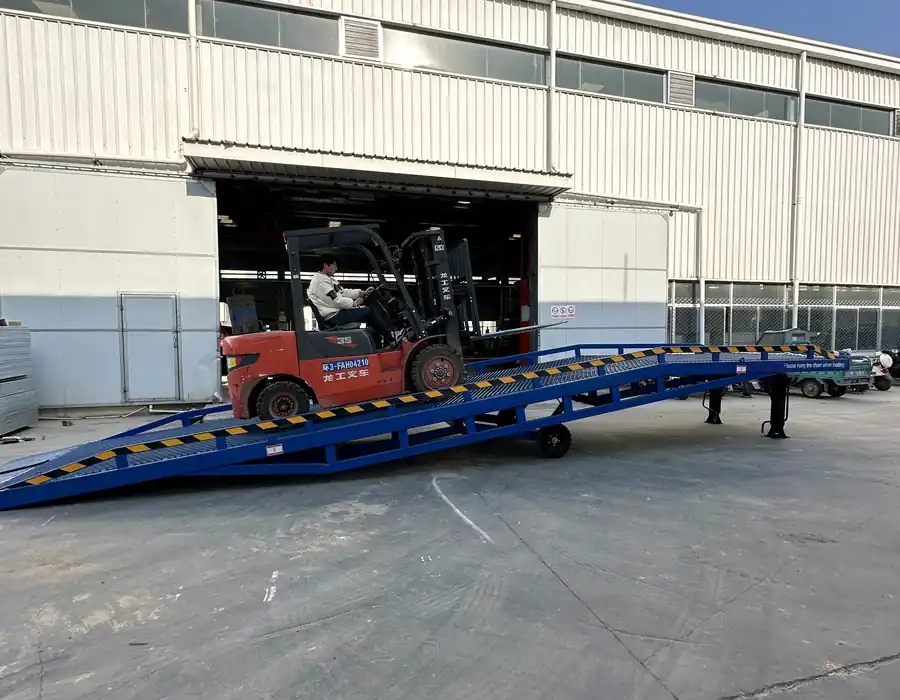
First, decide whether you need a mobile dock ramp
A mobile dock ramp, also known as a mobile yard ramp, creates a sloped route between the ground and a truck or shipping container. It allows a forklift to enter the vehicle when the site does not have a raised loading dock.
A mobile dock ramp usually suits operations where:
- the forklift starts at ground level;
- the loading point may change;
- one ramp must serve several vehicles;
- the site has no permanent loading bay; or
- the company wants to avoid major construction work.
A stationary dock leveler serves a different purpose. It connects an existing raised loading dock to the floor of a truck. Trucks normally reverse to the same loading bay, while the dock leveler stays in a prepared pit.
Therefore, choose a hydraulic dock leveler when you already have a permanent raised loading dock. In contrast, review Haolong’s mobile dock ramp models when the forklift must travel from the yard to the vehicle.
This choice matters because capacity cannot correct the wrong loading route. For example, a stationary dock leveler cannot replace the long approach of a mobile ramp. Likewise, a mobile ramp may take up unnecessary yard space at a permanent loading bay.
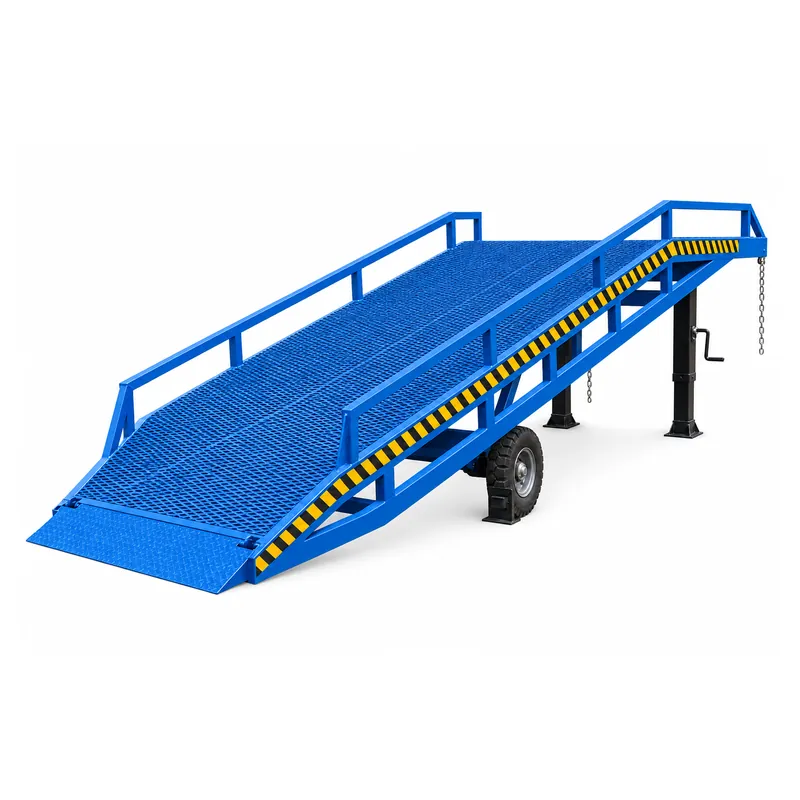
How to calculate mobile dock ramp capacity
First, calculate everything that will travel across the ramp:
Total moving load = forklift operating weight + operator + attachments + maximum cargo
Do not select the ramp from cargo weight alone. In many cases, the forklift weighs more than the cargo.
Also, do not confuse forklift lifting capacity with forklift operating weight. A forklift that can lift 3 tonnes does not necessarily weigh 3 tonnes. Battery size, mast type, tyres, fuel system and attachments can all change its operating weight.
You can usually find the correct operating weight on the forklift data plate or in the manufacturer’s manual.
Mobile dock ramp capacity example
Consider the following loading case:
| Load component | Example weight |
|---|---|
| Forklift operating weight | 4,300 kg |
| Operator | 100 kg |
| Attachment | 250 kg |
| Maximum cargo | 2,500 kg |
| Total moving load | 7,150 kg |
In this example, the ramp must carry at least 7,150 kg. However, this calculation does not automatically confirm that every 8-ton ramp will suit the application.
The ramp supplier must also check:
- forklift wheel loads;
- weight distribution;
- travel direction;
- number of loading cycles;
- ramp structure;
- deck width;
- working height; and
- actual site conditions.
Therefore, send the complete loading information to the supplier. Ask the supplier to confirm the model in writing instead of adding an unverified safety percentage yourself.
For projects in the United States, OSHA 29 CFR 1910.26(a) requires dockboards to support the maximum intended load. Other countries may use different rules, so buyers should also check local requirements.
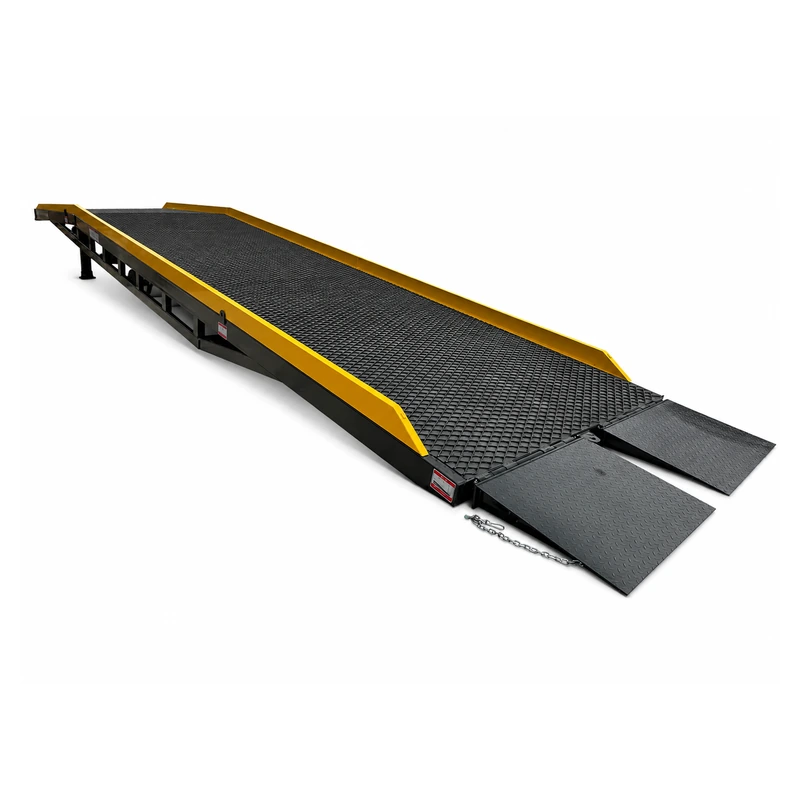
Match the ramp height to every vehicle
After checking capacity, measure the floor height of every truck or container that the ramp will serve.
Record both the lowest and highest vehicle floor heights. Do not rely on one standard truck height because several factors can change the actual measurement. For example, vehicle suspension, tyre size, cargo weight and ground slope can all affect the floor height.
For container loading, measure from the ground where the ramp will stand to the container floor. In addition, take the measurement under normal loading conditions.
Haolong offers different height ranges for different mobile dock ramp models:
| Reference model | Capacity | Working height range |
|---|---|---|
| HL-YD-6T | 6T | 1100–1800 mm |
| HL-YD-8T | 8T | 1100–1800 mm |
| HL-YD-10T | 10T | 1100–1800 mm |
| HL-YD-12T | 12T | 1100–1800 mm |
| HL-YD-15T | 15T | 1200–1800 mm |
| HL-YD-20T | 20T | 1200–1800 mm |
| HL-YD-30T | 30T | 1250–1800 mm |
These figures provide a starting point. However, buyers should confirm the final working range on the quotation and drawing. Never copy the height range from another model.
If your vehicles fall outside the standard range, send the lowest and highest measurements to the supplier. A custom height range may change the ramp length, slope and transition sections. As a result, it may also change the required yard space.
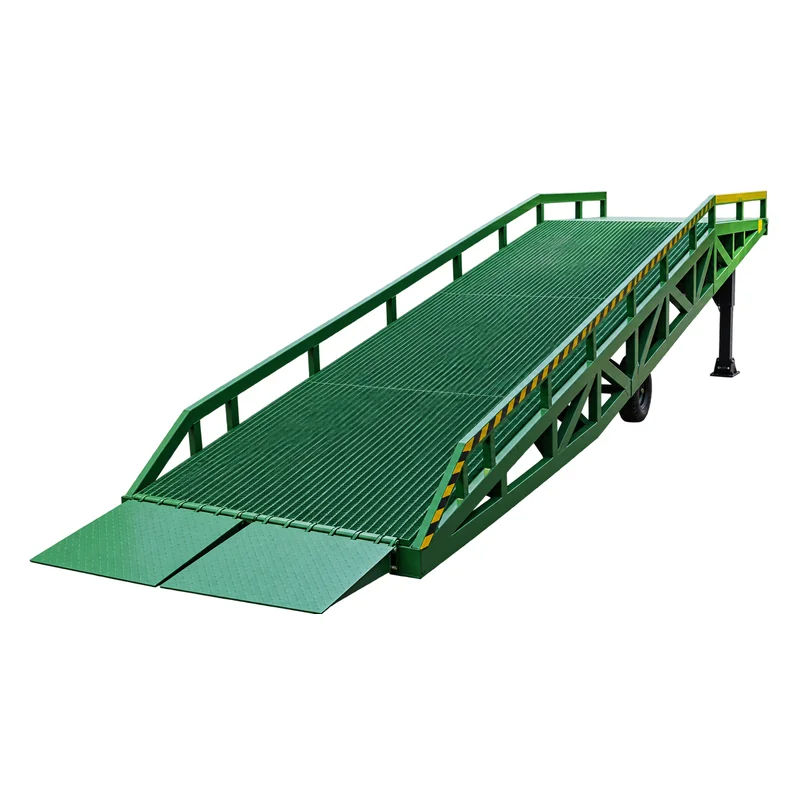
Check the clear width of the ramp
Next, compare the ramp’s clear deck width with the full travelling width of the forklift and cargo.
Check the following measurements:
- forklift body width;
- outside width of the tyres;
- width of the cargo;
- width of any attachments;
- truck or container door opening; and
- clear width between the ramp guardrails.
Haolong’s standard mobile dock ramp models provide clear widths from 2,000 to 2,900 mm, depending on the model. For example, the standard 12T model has a 2,200 mm clear width, while the 30T reference model has a 2,900 mm clear width.
However, the widest ramp does not always solve the problem. The truck or container door may create the narrowest point in the route.
Therefore, check the complete route from the yard to the vehicle. The forklift and cargo must pass through the approach area, ramp deck, transition plate and vehicle doorway with enough working clearance.
If you need a wider ramp, ask the supplier to review the complete structure. Increasing the width can affect the frame, beams, ramp weight and overall dimensions.
Make sure the yard has enough space
A standard Haolong mobile dock ramp measures about 11,300 mm in overall length, although the exact size depends on the model.
However, the ramp length represents only part of the required space. The forklift also needs room to approach the ramp, line up with the deck and turn safely.
Therefore, prepare a measured site drawing that shows:
- the available straight-line length;
- the proposed ramp position;
- the truck or container position;
- the forklift approach direction;
- the forklift turning area;
- nearby walls, columns and kerbs;
- drains or other ground obstacles;
- overhead doors or structures; and
- the route for moving the ramp.
Site photos also help the supplier understand the work area. However, photos cannot replace measurements. A photograph does not show exact distance, slope or door width.
In addition, check the ground condition. The ramp should stand on firm and level ground. Soft ground, damaged concrete, poor drainage or a steep slope can affect stability.
If the work area has any of these problems, correct them before using the ramp. Alternatively, ask for a site-specific review.
Review how workers will position and secure the ramp
A mobile dock ramp can move between loading points. However, it must not move during forklift loading.
Before operation, workers normally adjust the ramp to the correct height and connect it to the vehicle. They also use the specified support and restraint devices.
Depending on the selected model, these devices may include:
- adjustable support legs;
- connection chains;
- wheel chocks;
- side guardrails;
- an anti-slip deck; and
- vehicle restraint equipment.
Haolong’s standard manual hydraulic ramps use a hand pump and hydraulic cylinder to raise the deck. After height adjustment, the operator must use the mechanical supports according to the operating manual.
For US operations, OSHA 29 CFR 1910.26(c)–(e) covers several important points. For example, employers must prevent portable dockboards from moving out of a safe position. They must also stop the truck or trailer from moving while employees use the dockboard.
Therefore, confirm the following information before ordering:
- how workers will move the ramp;
- which towing method the manufacturer allows;
- how the ramp connects to the vehicle;
- which supports and chocks come with the ramp;
- how workers will secure the truck or container;
- what operators must inspect before each use; and
- which maintenance steps the manufacturer requires.
These checks support product selection. However, they do not replace the operating manual, staff training or local safety rules.
Consider loading frequency and working conditions
Two companies may carry the same maximum load but use their ramps very differently.
For example, one warehouse may load three trucks per week. Another distribution centre may run forklifts across the ramp many times during every shift. Although both sites need the same capacity, the second site has a much heavier duty cycle.
Therefore, tell the supplier:
- how many trucks you load each day;
- how many forklift trips you expect;
- how often you will move the ramp;
- whether you will use it indoors or outdoors;
- whether the site receives heavy rain;
- whether dust or debris collects on the deck; and
- whether the ramp may face corrosive materials.
This information helps the supplier review the frame, deck surface, hydraulic system, coating and maintenance needs.
In addition, describe any unusual operating condition. Do not assume that one capacity rating suits every site below that weight limit.
Information to send with your enquiry
A clear enquiry helps the supplier recommend a suitable ramp more quickly.
Send the following information:
| Required information | Why the supplier needs it |
|---|---|
| Forklift manufacturer and model | Confirms the correct machine data |
| Forklift operating weight | Forms part of the total moving load |
| Maximum cargo weight | Completes the load calculation |
| Operator and attachment weight | Prevents missing load components |
| Minimum vehicle floor height | Confirms the lower working limit |
| Maximum vehicle floor height | Confirms the upper working limit |
| Forklift and cargo width | Helps select the clear deck width |
| Vehicle door width | Checks the narrowest part of the route |
| Available yard length | Confirms that the ramp will fit |
| Turning area | Checks forklift access |
| Ground surface and slope | Helps assess ramp stability |
| Loading frequency | Defines the duty cycle |
| Indoor or outdoor use | Helps select the finish and deck |
| Destination country | Helps identify electrical and document needs |
| Site drawing and photos | Shows the complete loading layout |
Haolong currently offers 6–30T mobile dock ramps with different widths and working height ranges.
Finally, ask Haolong to list the selected capacity, dimensions, supports, restraints and options in the quotation and approved drawing. This step gives both parties a clear technical reference before production.
Common mobile dock ramp selection mistakes
Choosing capacity from cargo weight alone
The forklift often weighs more than the cargo. Therefore, always include the forklift, operator and attachments in the total moving load.
Using forklift lifting capacity as forklift weight
These figures describe different things. Check the forklift data plate or manual for the actual operating weight.
Assuming every model has the same height range
Working height changes between models. Therefore, compare the exact quoted model with the lowest and highest vehicle floors.
Checking ramp width but ignoring the vehicle door
The truck or container opening may create the narrowest point. Check the full loading route rather than the ramp alone.
Measuring the ramp but not the approach area
The forklift needs enough space to line up and turn before entering the incline. Therefore, include the approach and turning area in the site drawing.
Ignoring the ground condition
A strong ramp still needs a firm and level base. Repair weak, sloped or damaged surfaces before operation.
Treating a sales page as an operating manual
Product pages help buyers compare equipment. However, operators must follow the manual supplied with the selected model.
Frequently asked questions
What mobile dock ramp capacity do I need for a 3-ton forklift?
A 3-ton lifting capacity does not tell you the forklift’s operating weight. First, find the operating weight on the forklift data plate. Next, add the operator, attachments and maximum cargo. Then send the complete load calculation to the ramp supplier for confirmation.
Can one mobile yard ramp serve trucks of different heights?
Yes, if every vehicle floor falls within the working range of the selected ramp. Therefore, measure both the lowest and highest vehicle floors before choosing a model.
Does a manual hydraulic dock ramp need electricity?
Haolong’s standard manual hydraulic ramps use a hand pump for height adjustment. Therefore, they do not need electricity for this function. A powered option may require a confirmed voltage, frequency and control system.
Can Haolong customize the ramp width or height range?
Haolong can review custom dimensions for a specific project. However, changes to width or working height may also change the frame, slope and overall size. Send the complete loading and site information before requesting a custom ramp.
Can I use a mobile dock ramp at a permanent loading bay?
You can use a mobile ramp for some loading layouts. However, a stationary dock leveler usually provides a better solution for frequent loading at a permanent raised bay.
How much space does a mobile dock ramp need?
Start with the ramp’s overall length. For Haolong’s standard models, this length is about 11,300 mm. Next, add enough space for the forklift to approach, line up and turn. The final requirement depends on the forklift and site layout.
Choose the ramp from the complete loading process
Mobile dock ramp capacity provides the first selection point, but it does not provide the final answer.
First, calculate the complete moving load. Next, check the vehicle height range and clear deck width. Then confirm the yard space, ground condition, loading frequency and restraint method.
Together, these checks help the supplier match the ramp to the actual loading process.
For a project-specific recommendation, send your forklift data, cargo weight, vehicle heights, site measurements and loading frequency through Haolong’s project enquiry form. Also request the proposed model specification and drawing before production.
References
- Haolong, Mobile Dock Ramps for Forklift Loading
- Haolong, Hydraulic Dock Levelers, 8T & 10T
- U.S. Occupational Safety and Health Administration, 29 CFR 1910.26 – Dockboards