Mixed vehicle loading
Raise the same platform to serve different truck-bed heights and vehicle types.
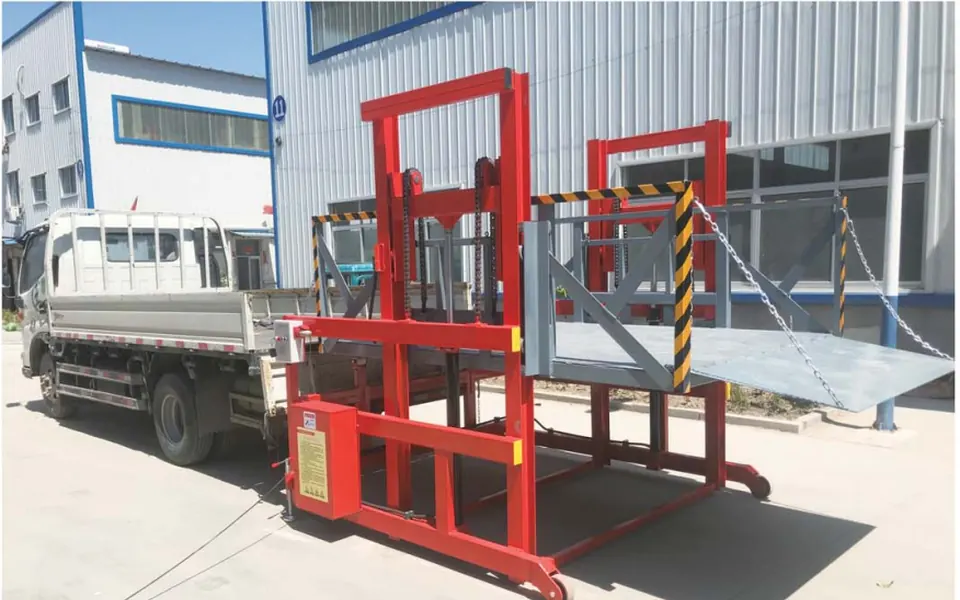 Mobile Loading Platform gallery
A pit-free hydraulic work platform that creates a level staging area beside different vehicles and can be repositioned when the loading point changes.
Choose a mobile loading platform when goods need to be staged, turned or transferred on a level deck before entering vehicles of different sizes.
Raise the same platform to serve different truck-bed heights and vehicle types.
Provide a larger work area for pallets, cartons or equipment before transfer into the vehicle.
Reposition the platform when loading zones, production lines or warehouse layouts change.
The application needs a level staging deck, varied vehicle heights, pit-free installation and flexible loading positions.
If a forklift only needs a sloped route from ground to truck, use a mobile dock ramp. For a permanent raised dock, use a stationary dock leveler.
This equipment is configured by project. Final values depend on platform activities, load distribution, lift travel and vehicle interface.
| Configuration item | Standard direction | Available option | Key input | Final status | Document |
|---|---|---|---|---|---|
| Platform deck Reference | Sized to application | Custom L × W | Goods + operator space | Confirm by drawing | GA drawing |
| Rated capacity | Engineered to load | Custom | Total distributed / point load | Engineering review | Load schedule |
| Lift travel | Vehicle-height range | Custom | Min / max vehicle floor | Confirm by drawing | Travel data |
| Control method | Local pendant | Wireless remote option | Operator position | Order selection | Electrical list |
| Mobility | Mobile chassis | Tow / manual positioning | Route and ground | Site review | Layout plan |
Provide the loading sequence—not only a target capacity—so deck size, travel and controls can be selected together.
Send project details →The platform combines a stable lifting structure, level work deck, vehicle transition and mobile base in a site-specific arrangement.
Vertical guides support stable platform travel during height adjustment.
The larger deck provides space to position goods before transfer into the vehicle.
Hydraulic power raises and lowers the platform through the specified vehicle-height range.
A hinged or fitted bridge connects the level deck to the vehicle bed.
The chassis supports repositioning; local or wireless controls can suit the operating sequence.
Safety configuration is based on who uses the platform, how goods are moved and what happens at every open edge and vehicle interface.
Perimeter rails and controlled access points protect the elevated work area.
Configured controls help prevent movement when access conditions are not satisfied.
Accessible stop controls interrupt powered movement when required.
Service support or locking provisions protect authorised maintenance work.
The work surface supports secure footing and material-handling traction.
The mobile base is secured before lifting or loading begins.
Deck size, lift travel, capacity and access protection are selected from what moves, who operates, how the vehicle is approached and where the platform is stored.
Send project requirements →Set usable platform area and rated load from goods, equipment, people and load distribution.
Match the minimum and maximum platform level to the actual vehicle fleet.
Configure gates, bridge plate and entry direction around the transfer sequence.
Choose local pendant, wired control or wireless remote according to operator position.
Confirm movement method, wheel restraint, colour and outdoor protection.
Deck size, guide structure, travel, access protection and controls are reviewed as one system before fabrication.
Load, vehicle, site and operating conditions are checked.
Dimensions, structure, controls and interfaces are documented.
Fabrication and functional checks follow the confirmed scope.
Shipping preparation and technical documents are arranged.
A dock ramp mainly creates a sloped forklift route. A mobile loading platform provides a larger level staging deck that can be raised to different vehicle heights.
The mobile guide-rail configuration is designed for pit-free use, subject to a suitable firm and level operating surface.
Yes, the lift travel can be configured around the minimum and maximum vehicle floor heights provided for the project.
Yes. Platform length, width, capacity, travel, access direction and control method are project-specific.
A wireless remote can be included as an option. The final control arrangement should match operator visibility and the loading sequence.
Only if the platform is specifically engineered for the forklift, cargo, wheel loads, deck dimensions and transition conditions. State this requirement before design.