Space-limited yards
Fold the long approach into a more compact parked form after loading.
Telescopic Dock Ramp gallery
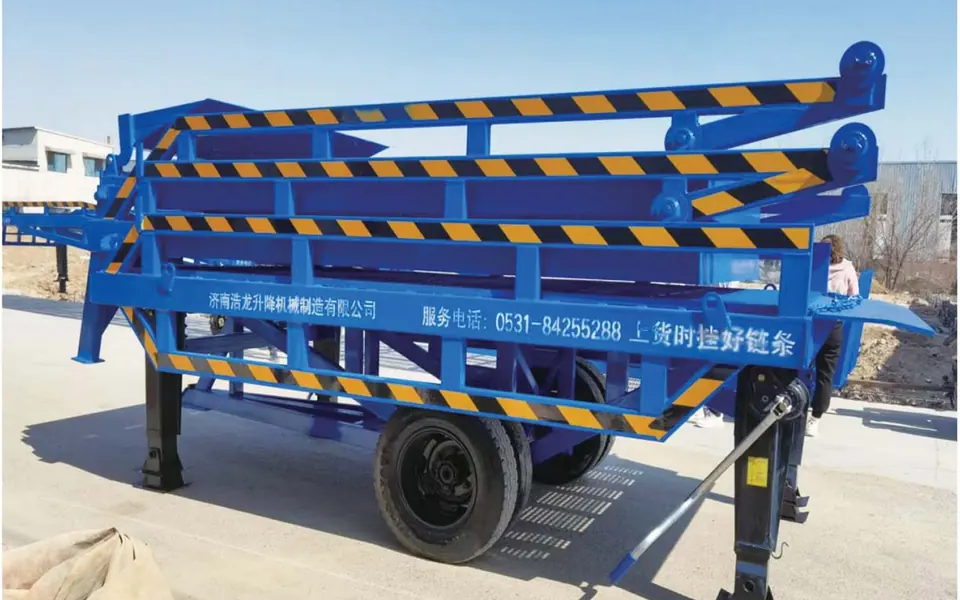
A folding multi-section loading ramp that provides a long forklift approach when deployed and reduces the storage footprint between loading operations.
Choose a telescopic dock ramp when the forklift needs a gradual approach to vehicle height but the full ramp length cannot remain deployed between operations.
Fold the long approach into a more compact parked form after loading.
Move the folded unit to different loading positions without permanent civil work.
Create a controlled forklift approach where vehicle height and available slope require more length.
A long forklift approach is required, the equipment must remain mobile, and the parked footprint needs to be reduced.
Use a standard mobile dock ramp when there is enough permanent approach space. For a prepared raised dock, use a stationary dock leveler.
The values below describe the representative three-section concept. Final capacity, dimensions and slope require a project drawing.
| Configuration | Extended size | Folded size | Capacity | Height range | Operation |
|---|---|---|---|---|---|
| Three-section mobile Reference | Approx. 12.2 × 2.42 m | Confirm by drawing | Project-specific | Project-specific | Hydraulic folding |
| Custom long-reach | Defined by site | Defined by transport space | Engineering review | Defined by vehicle fleet | Hydraulic / custom |
Provide both the required working reach and the maximum parked or transport envelope before quotation.
Send project details →The multi-section structure must balance approach angle, folding movement, wheel loads, mobility and stable support in both working and stored positions.
Hinged structural sections create a long deployed route and fold into a shorter storage arrangement.
Hydraulic actuation assists raising, lowering and section movement during setup.
Deck structure and anti-slip surface are designed around the specified forklift wheel loads.
Wheels, towing point and stabilising supports allow repositioning and secure working setup.
Approach and vehicle-end plates are coordinated with the deployed geometry.
A folding ramp adds moving sections and stored energy, so setup control, support deployment and exclusion zones require particular attention.
Specified mechanical locks or restraints secure sections in the working or transport state.
Supports are deployed on firm ground before forklift traffic begins.
Chains or specified restraints reduce separation from the truck or container.
Visible rails define the elevated forklift path along each section.
Hydraulic movement should be performed only within the designated clear zone.
Chocks or braking measures prevent movement after positioning.
The correct solution depends on working reach, allowable slope, vehicle height, parked footprint and how the folded ramp will move through the site.
Send project requirements →Define the horizontal approach length and target vehicle-height range.
Confirm maximum parked dimensions, transport route and storage area.
Engineer structure and deck width around the complete moving load and forklift geometry.
Configure towing, tyres, turning clearance and stabilising positions.
Confirm hydraulic operation, control position, safety marking and coating.
The engineering review checks deployed slope, folding clearance, support positions and transport envelope before fabrication begins.
Load, vehicle, site and operating conditions are checked.
Dimensions, structure, controls and interfaces are documented.
Fabrication and functional checks follow the confirmed scope.
Shipping preparation and technical documents are arranged.
Choose it when you need a long working approach but cannot keep the full ramp length deployed or stored in one straight line.
No. Approximately 12.2 m is a representative three-section configuration from the Haolong catalogue. Final length and width are confirmed by drawing.
Use the combined maximum weight of forklift, operator, attachments and cargo, then provide forklift wheel and dimension information for review.
Provide required vehicle height, available working length, maximum folded storage space, clear width, turning route and ground condition.
The mobile structure can be configured for low-speed site repositioning. Towing route, turning clearance and folded transport state must be confirmed.
Use firm level ground, establish a clear exclusion zone, inspect hydraulics and locks, and follow the supplied setup sequence.